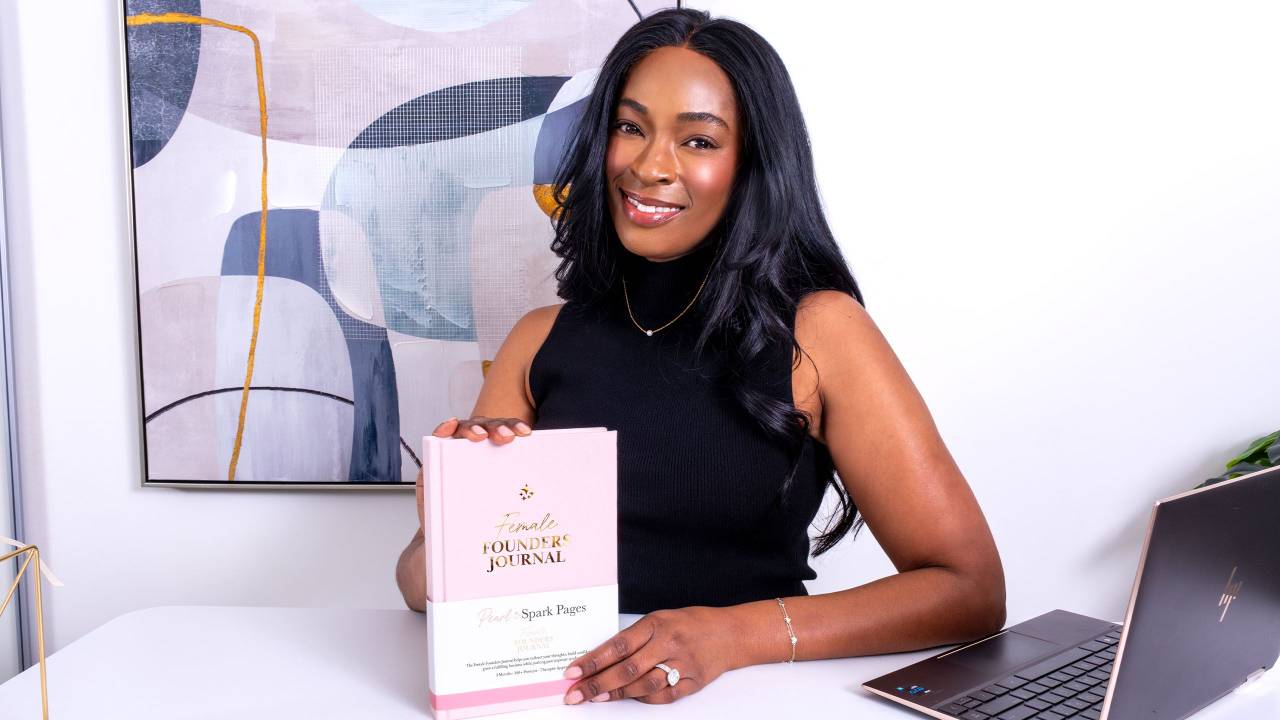
How To Start Investing For Retirement When You're Self-Employed. Episode 333
Aug 18, 2026
Stop Leaving Money on the Table: Why Every Ecommer Store Owner Needs a Financial Plan
Building wealth when you're your own boss
Here's something I hear all the time: "I'm too busy building my business to worry about my finances."
I get it. When you're running your own business, every minute feels precious, and financial planning can seem like a luxury you can't afford. But here's the thing, it's actually the opposite. Not having a solid financial plan is what costs you money.
That's exactly why I wanted to bring Chloe Daniels on the podcast. Chloe is a money coach who works specifically with self-employed women and business owners, and her story is pretty inspiring. She went from being terrified of money to building a multi-seven-figure business helping other people do the same.
But more importantly, she's figured out how to make this stuff simple—and dare I say, not terrifying.
The Big Myth About Getting Good With Money
"Dumber people than you have figured it out before."
Chloe told me this is her favorite life mantra, and honestly, it might be the most liberating thing I've heard in a while. Because here's the truth: managing money is not complicated. It's not a skill reserved for people with fancy degrees or naturally mathematical minds. It's a skill. Which means you can learn it.
For years, Chloe believed she was "bad with money." She relied on romantic partners to handle finances. She was an emotional spender. She got into debt more than once. But in 2018, something clicked. She realized that staying the same (living in financial chaos) scared her way more than trying something new. So she taught herself.
What started as pure survival became an obsession. She took CFP (Certified Financial Planner) courses. She learned about investing. She started coaching people. And now? She runs a business that's generated millions of dollars in revenue.
Her transformation proves something important: this isn't about being naturally gifted with money. It's about deciding you're worth taking care of.
Self-Employed People Have More Options (And Most Don't Know It)
One of my frustrations as a business owner has always been this: why does retirement planning seem designed for people with W2 jobs? When you're self-employed, there's no employer match. There's no HR team setting things up for you. You're on your own.
But here's what Chloe pointed out that blew my mind: self-employed people actually have MORE retirement account options than traditional employees. Not fewer. More.
This is a game changer, and most of us don't realize it. Here's what's available to you:
A Solo 401(k)
allows you to contribute both as the employer and the employee—which means you can put away over $60,000 a year. For someone making $175,000 annually, this is huge. If you put $50,000 into a solo 401(k), you're reducing your taxable income by $50,000. That's substantial tax savings.
A Roth IRA or Traditional IRA
lets you contribute $7,500 a year (or $8,600 if you're over 50). These are good starting points because the fees are typically lower than a 401(k).
SEP IRAs and Simple IRAs
are also options, depending on whether you have employees.
The beautiful part is you can start any of these today. You don't need permission. You don't need to wait for open enrollment. You just need to make a decision.
"Even if you can just do $100 a month and get to $100,000 before age 50, that's going to put you in such a better position."
This matters. Because Chloe showed me actual numbers. If you're 50 years old and you already have $100,000 invested, and you start putting in $1,500 a month for the next 15 years (at an 8% average return), you'll have $800,000 by age 65.
If you're 50 and you have $0 invested, and you put in that same $1,500 a month? You'll have $488,000. Almost half.
The difference between early action and waiting is literally hundreds of thousands of dollars.
The Lump Sum Investing Question That's Keeping You Stuck
One of my biggest challenges as a business owner is the inconsistency of income. Some months are amazing. Other months, we're bleeding money. The idea of setting up a "regular" $500/month investment feels risky when I might need that money to cover expenses.
Chloe gets this. She works with clients who have the same problem. And her solution is brilliant: stop thinking in terms of huge sums and start thinking in terms of "your bare minimum."
Here's how it works. Look at your best months and your worst months. Find a number—even if it's just $100—that you could commit to investing every single month, even in your worst months. Make it a non-negotiable bill, just like your mortgage or your utilities.
Yes, $100 a month might feel small. But it's something. It's consistency. It's building the habit. And over 20 years, $100 a month grows into real money, especially with compound interest.
The key insight here is this: you don't need to wait for perfect financial conditions to start investing. You need to start with what you can do now.
"Having more money in the future is always going to be better than having no money in the future."
What About Debt? Do You Pay It Off First or Invest While You Pay?
Here's where the personal finance advice gets controversial. You've probably heard someone (Dave Ramsey, maybe?) say you need to pay off all your debt before you invest a single penny. And yes, debt is a problem.
But Chloe pointed out something really important: the answer is not one-size-fits-all. It depends.
If you have high-interest debt (like credit cards at 18%), that's a different story than a mortgage at 6-7%. If you're 45 years old with no retirement savings, the math changes. If you're 30, it's different.
The real skill isn't following someone else's debt payoff formula. It's learning how to run the numbers for YOUR situation. That's what Chloe teaches. She gives people a framework to calculate: if I pay off debt first and wait to invest, versus if I pay minimums and invest now, which strategy gets me to retirement with more money?
Sometimes the answer is "pay off debt first." Sometimes it's "invest while you pay." The point is: make the decision based on facts, not emotions or what someone else says you "should" do.
The Time Investment is Smaller Than You Think
Here's the objection I hear most: "This is going to take so much time, and I don't have it."
Chloe's answer? The learning takes time. The maintenance takes barely any.
Her course is 10 hours of work. Once you've got it set up—once you understand how to allocate your investments, set up automatic contributions, and choose your investments—you're basically done. She said it takes her maybe an hour a year to rebalance.
An hour a year. That's not a lot to ask for your financial security.
So the real investment is upfront learning. You need to spend a month, maybe two, understanding how this all works. After that, it's mostly automated. Set it and forget it.
What If You're Already 50 and You Haven't Started?
This might be the most important section I write, because someone reading this right now is thinking: "I'm too late. I'm already 50 (or 55 or 60) and I haven't even started."
Chloe's message is clear: You are not too late. It's not too late.
She said something I'll never forget: "I've had so many people come in and they're 52 with nothing invested for retirement, and they're still going to end up with a million dollars by the time they retire."
And she's serious. A million dollars. Starting at 52 with zero. It's solvable.
The real issue isn't that you're too late. It's that you have to remove the shame. This is not your fault. Nobody taught you this. Your school didn't teach it. Your parents might not have either. You're not bad with money because you didn't know, you didn't know because nobody told you.
So here's what you do: you get started. You run the numbers. You see what you actually need. You make a realistic plan. And you get to work.
Will you have to invest more aggressively? Probably. Will you have to work a bit longer? Maybe. But "later than ideal" beats "never." Every single time.
"You have to decide at the beginning of the month, 'This is how much I'm going to invest,' and then everything else afterwards is what we spend. That's one of the biggest mindset shifts most people have to make."
The Real Bottom Line
Building financial security as a self-employed store owner is not complicated. It's not impossible. It's not reserved for people who are naturally gifted with numbers.
What it requires is: a decision, a plan, and consistency.
You already know how to build a business. You know how to solve problems, adapt, and move forward even when things are uncertain. Those same skills apply to money. You just need to learn the framework.
The biggest difference between someone who's financially secure at 65 and someone who isn't, is not luck. It's that one person started. They made the decision, got clear on the numbers, set up a plan, and stuck with it.
That can be you. Starting today.
Want to go deeper? You can find Chloe Daniels at clovebear.com. She hosts free weekly investing workshops and offers a course called The Lazy Investor that walks you through exactly what we discussed here—at your own pace, with community support.
And remember: if you aren't financially healthy, it's really hard to run a good business. Taking care of your personal finances is not selfish. It's essential.
RELATED LINKS:
You can find Chloe Daniels at clobare.com
How to Scale Without Borrowing (or Breaking Your Business) https://www.thesocialsalesgirls.com/blog/how-to-scale-without-borrowing-or-breaking-your-business-episode-279
3 Things you can do to be more profitable today https://www.thesocialsalesgirls.com/blog/3-things-you-can-do-to-be-more-profitable-today-episode-219
How to create profit goals https://www.thesocialsalesgirls.com/blog/how-to-create-profit-goals-episode-209
Gross Profit: Will you take charge and pay yourself more? https://www.thesocialsalesgirls.com/blog/gross-profit-will-you-take-charge-and-pay-yourself-more-episode-188